Vesper  Updates

Fish & Seafood Prices via Undercurrent Partnership

by Vesper Team
New
Data
Partnerships
Fish & Seafood

Over 2,000 Fish & Seafood price series are now available on the Vesper platform through an integration with Undercurrent, a specialist seafood data provider.

What's new:

  • 2,000+ price series across 15 product groups within Fish & Seafood

  • Global and regional coverage from a specialist seafood data provider

  • Data accessible through your existing Vesper dashboards

Important: Bring Your Own License Undercurrent data requires an active Undercurrent subscription. If you already subscribe to Undercurrent, contact your Customer Success Manager to activate access within Vesper. This model lets you view your Undercurrent data alongside all your other commodity benchmarks in one platform.

Why this matters: Seafood markets are among the most fragmented and volatile in food commodities. Prices vary by species, origin, catch method, and season. That makes it difficult to track costs or compare supplier quotes with any confidence. With Undercurrent data in Vesper, teams across procurement, finance, and category management can check quotes, compare prices, and track trends for fish and seafood. All in the same workflow you use for other commodities.

How to access? Contact your Customer Success Manager at [email protected] to activate Undercurrent data on your account.
Nuts, Seeds & Dried Fruits News

by Vesper Team, Product Marketing
New
Nuts, Seeds & Dried Fruits
News & Alerts
AI

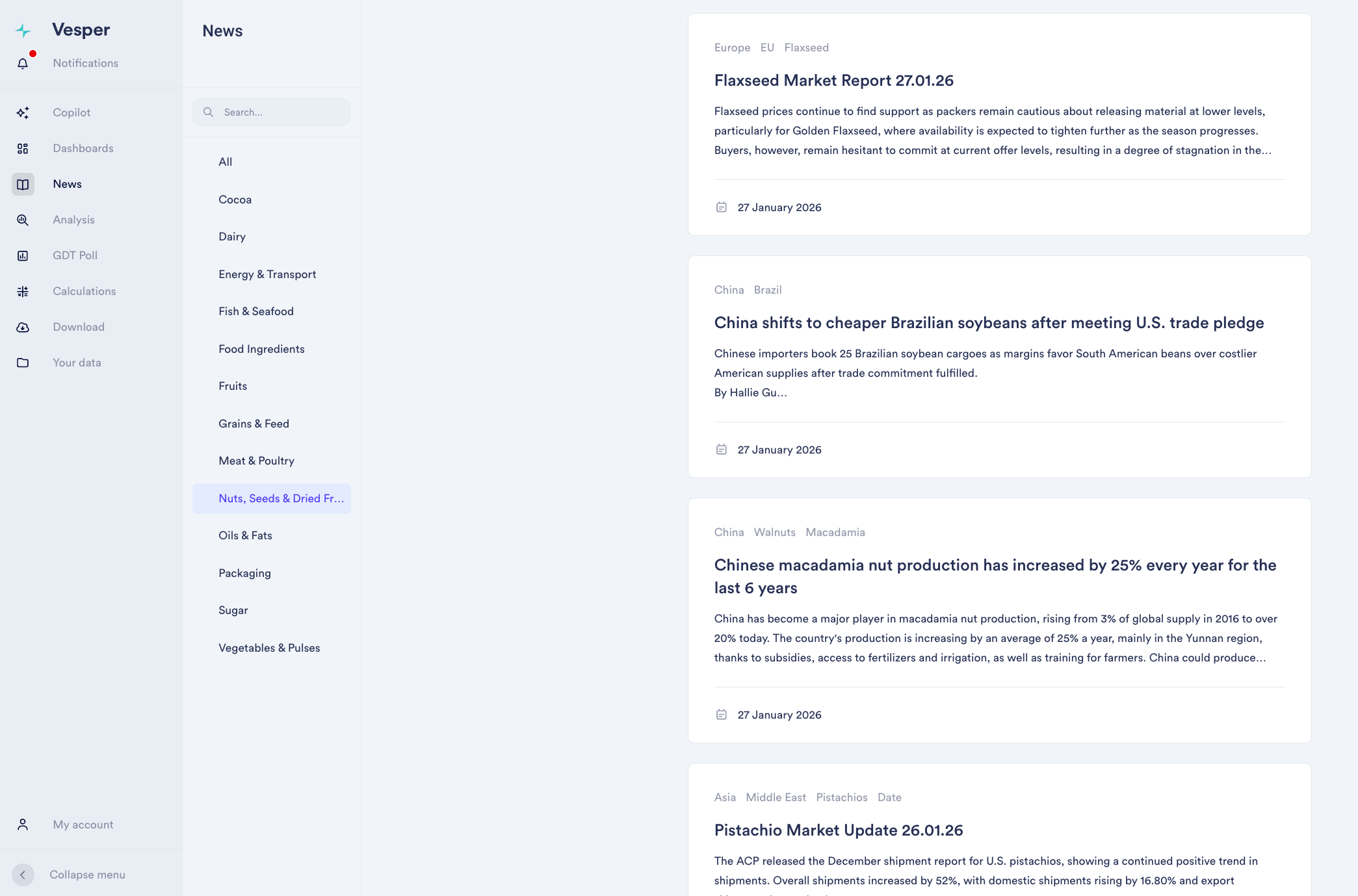
Stay on top of market developments across nuts, seeds, and dried fruits with a dedicated news feed now live in Vesper.

What's new

  • New Nuts, Seeds & Dried Fruits news feed available in the News section

  • Global and local coverage across key origin countries

  • Topics include supply disruptions, harvest updates, trade flows, regulatory changes, and demand trends

  • Filtered and curated for relevance, cutting through the noise

Why this matters

Nuts, seeds, and dried fruits are highly exposed to origin-specific risks, climate impacts, and trade dynamics. At the same time, public price transparency is often limited.

This news feed fills the gap. It gives you context around market movements, helping you understand what's driving prices and anticipate volatility before it shows up in the numbers.

Did you like this update?

LikeNeutralDislike

205 new Mexico price series from SNIIM

by Vesper Team
New
Data
Fruit
Vegetables & Pulses
Herbs & Spices
Grains & Feed
Nuts, Seeds & Dried Fruits

Vesper has added 205 price series from SNIIM, Mexico's national food price information system. This update includes 168 products that are new to the platform.

What's new:

  • 205 new price series from SNIIM (Sistema Nacional de Información e Integración de Mercados)
  • 168 newly created products
  • Coverage by category:
    • Fruits: 86 series
    • Vegetables & Pulses: 76 series
    • Herbs & Spices: 24 series
    • Grains & Feed: 9 series
    • Nuts, Seeds & Dried Fruit: 6 series
    • Beverages: 2 series
    • Sugar: 2 series

Why this matters:

Mexico is a major origin market for fresh produce, herbs, and specialty ingredients sourced by North American and European food manufacturers. SNIIM data gives buyers an official government reference for regional spot prices. Useful for verifying quotes, tracking seasonal price patterns, and benchmarking cross-border sourcing for categories like avocados, chilies, tomatoes, and tropical fruit.

How to Use It:

  • Prices Widget: search by product name or filter by Mexico as origin market
  • Price Comparison: compare SNIIM prices against other regional sources for the same commodity
  • Cost Models: add Mexican produce prices as inputs to ingredient cost models

How to access?

Add to new or existing dashboards using the search function, or contact your Customer Success Manager at [email protected].

Bring Your Own Data (BYOD)

by Vesper Team, Product Marketing
New
Vesper Toolbox
Data
Cost Models

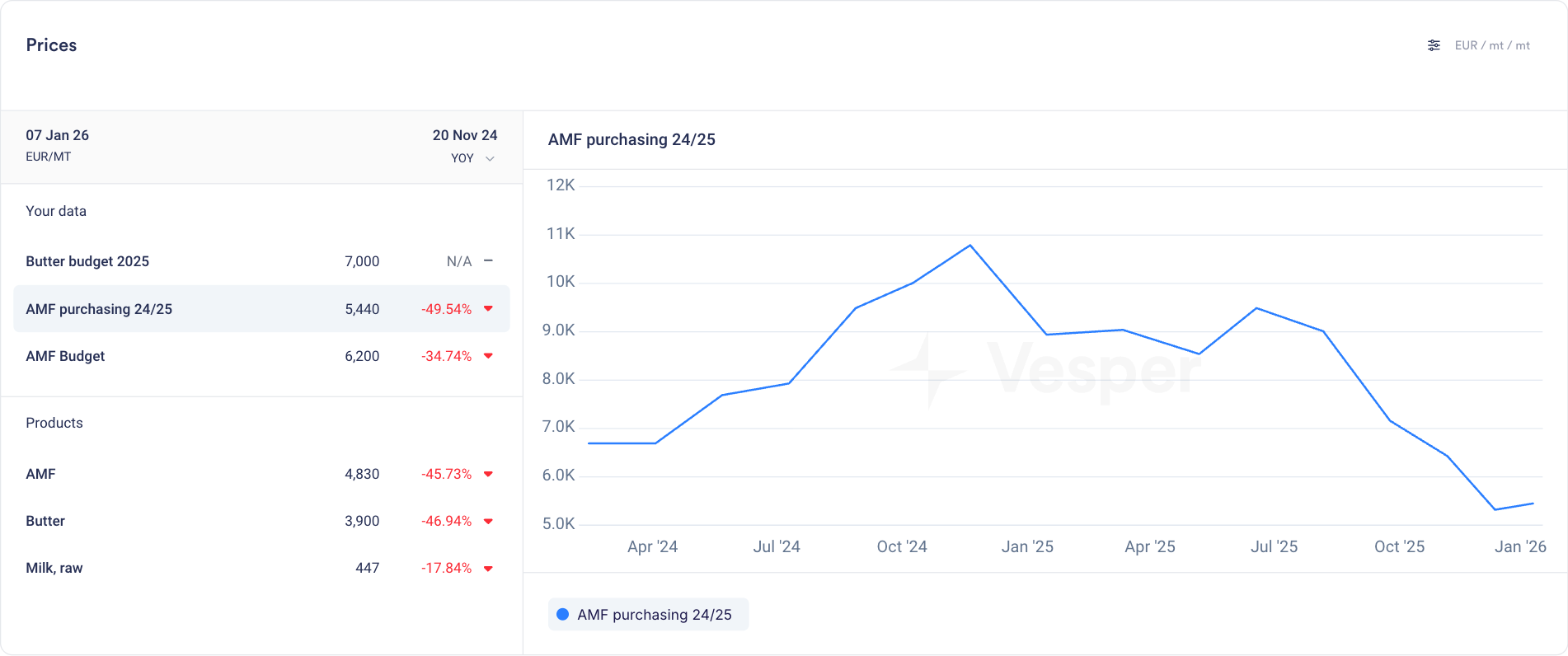
Upload your own budgets, purchase prices, and supplier quotes directly into Vesper. Your internal data now lives alongside global market intelligence, all in one place.

What's new

  • Add your own data via manual entry or CSV upload

  • Store budgets, contract prices, supplier quotes, or any internal pricing data

  • Unlimited series and products with no caps on what you can bring in

  • All your uploads organized in a new dedicated "Your Data" section

  • Access your data in the Prices widget, Price Comparison, and Cost Models

  • Use the full Vesper toolbox on your own data: visualize spreads, calculate averages, and add notes directly in graphs

  • Use your data as inputs for cost models and custom formulas

Why this matters

Vesper already lets you build custom benchmarks using formulas and cost models. Now you can go further. Bring in your actual purchase history, budget targets, and supplier offers to see the full picture.

  • Track performance: Compare what you paid against what the market did

  • Spot opportunities: See where your prices diverge from benchmarks over time

  • Centralize everything: Stop toggling between spreadsheets and Vesper. Make it your single source of truth.

Your data stays yours

Everything you upload is siloed, secure, and never shared with other users or used in any Vesper Price Index. Your competitive information remains private.

Did you like this update?

LikeNeutralDislike

Cost models in Price comparison

by Vesper Team, Product Marketing
New
Vesper Toolbox
Cost Models
Data
Vesper Price Index (VPI)

You can now compare your cost models directly against actual prices and other cost models in the Price Comparison widget.

What's new

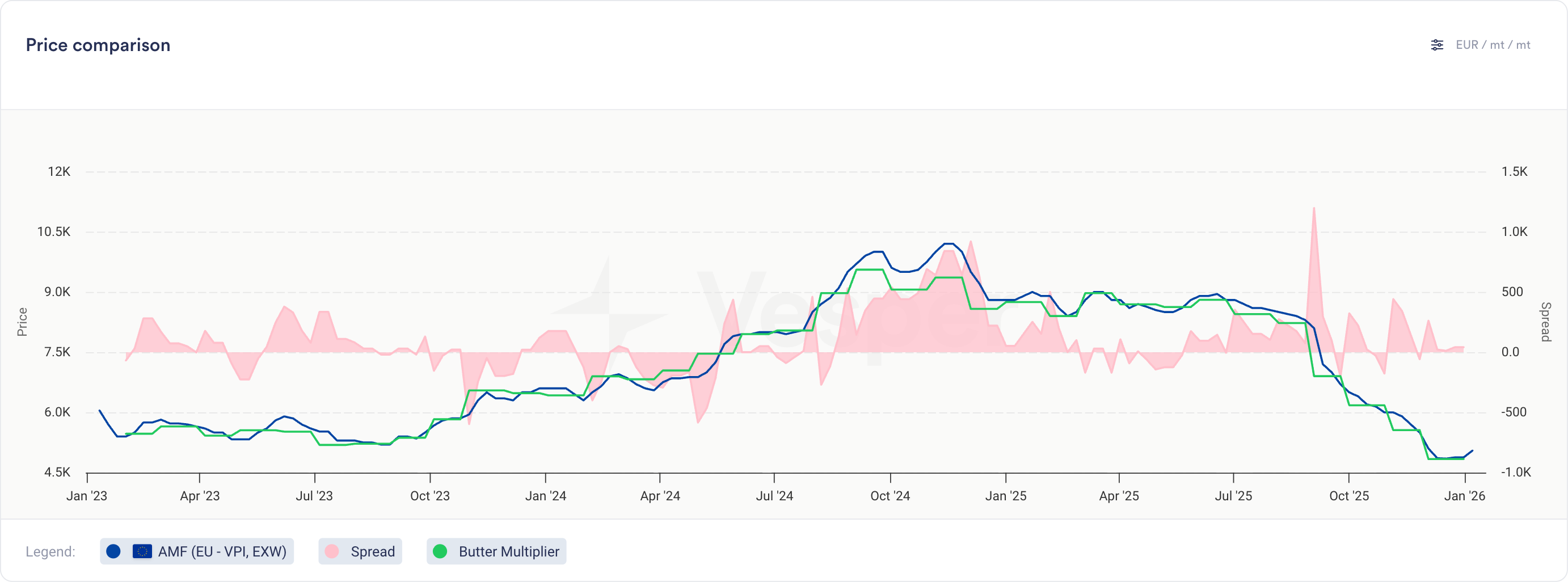
  • Cost models now appear as selectable series in the Price Comparison widget

  • Select cost models from the product dropdown, labeled with their cost model name

  • View cost model historical data alongside multiple other cost models, price series, or any combination of both

  • Same visualization and interaction as product prices (line charts, tooltips, trends)

  • Note: Notes cannot be added to cost models

Why this matters

For finished goods, this bridges cost modeling and price analysis:

  • Compare different recipe options to find the most cost-effective formulation

  • Validate actual paid prices against theoretical cost models to spot inefficiencies

  • Track variance trends over time to identify negotiation opportunities

For commodity and ingredient buyers, this opens up new ways to analyze contract structures:

  • Build indices for weighted baskets and compare against other indices or your own prices

  • Model multiplier or fixed cost-plus structures on top of any benchmark

Did you like this update?

LikeNeutralDislike

Cost Model Forecast & Collaboration

by Vesper Team, Product Marketing
New
Cost Models
Forecasting & Outlook
AI

Vesper has launched Advanced Cost Model Collaboration & Forecasting, transforming how procurement teams build, share, and predict product costs. These features eliminate silos between team members and bring AI-powered forecasting directly into your cost models, enabling real-time collaboration on forward-looking procurement strategies.

What's New:

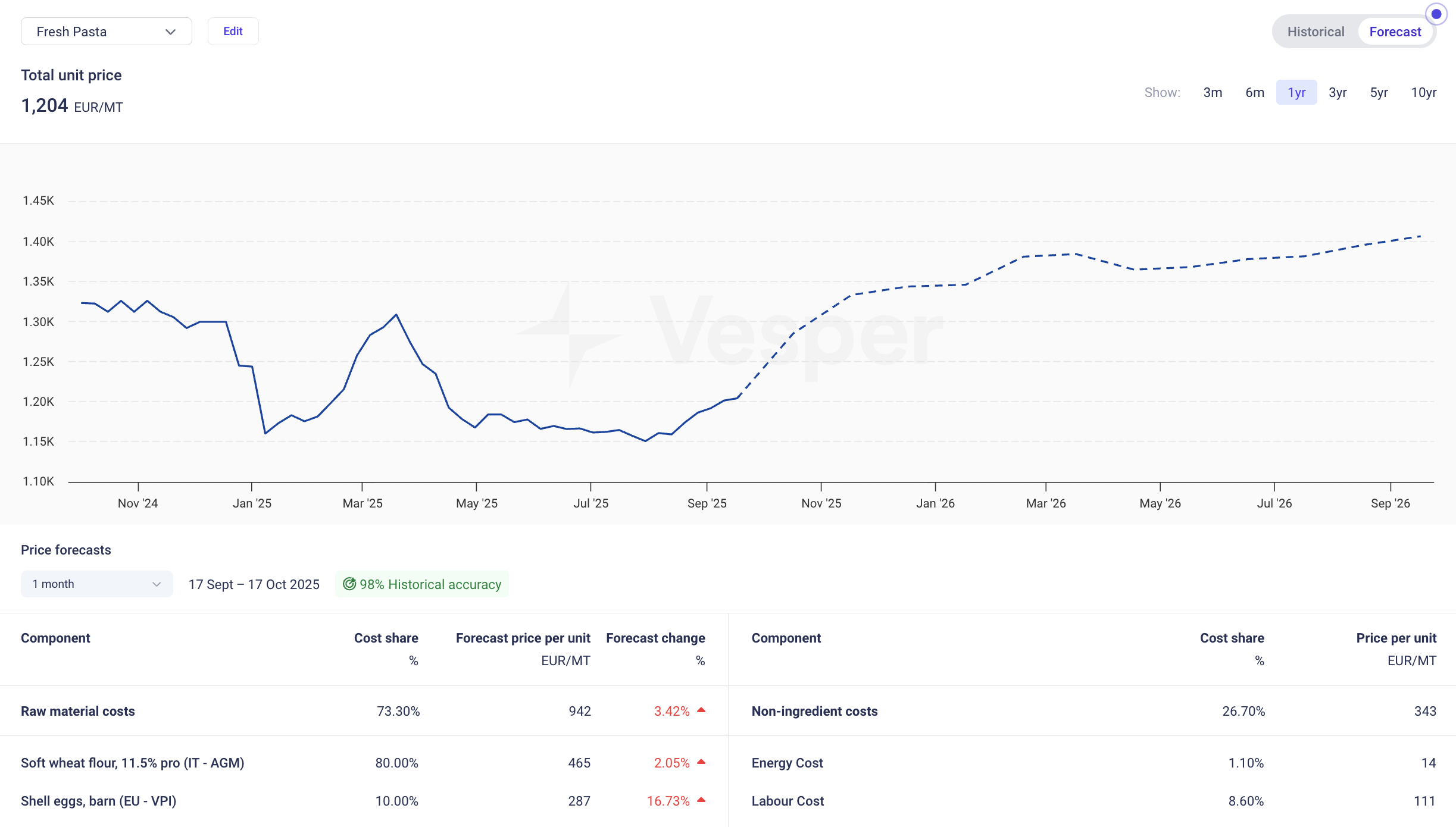
  • Cost Model Forecasting: View your total product costs up to 12 months ahead (depending on forecast availability). Toggle between historical and forecasted values with full accuracy calculations, detailed forecast tables showing price movements per ingredient, and weighted accuracy scores.

  • Cost Model Sharing: Share any cost model across your organization with granular access controls. Grant view-only permissions for stakeholder reviews or edit access for joint development, with all shared models appearing in a dedicated library.

  • Cost Model Collaboration: Work collaboratively on shared models with real-time updates visible to all collaborators. Receive notifications when colleagues share models or make edits, ensuring alignment on the latest cost structures.

Why It Matters: Cost models trapped in individual spreadsheets create bottlenecks and duplicate work. Meanwhile, static historical data leaves teams reactive rather than proactive. This update enables procurement teams to collaborate on living cost models that look forward, not only backward, turning isolated analysis into coordinated teamwork with visibility into future cost drivers.

How to Use It:

  1. Access forecasting by clicking the toggle in any cost model widget to switch between historical and forecast views

  2. Share models by selecting "Edit" in the cost model widget, then using the share option under "Access"

  3. Set permissions as either "Can view" for stakeholder visibility or "Can edit" for collaborative development

  4. Find shared models in the dedicated section of your cost model dropdown, marked with company models

  5. Monitor changes through the Notifications banner for updates on shared models

How to access? These features are live for all Vesper users. Contact your customer success manager at [email protected] for training on maximizing collaboration workflows.

Did you like this update?

LikeNeutralDislike

Cost Models: Turn commodity benchmarks into product pricing

by Vesper Team
New
Food Manufacturing
Retail
Cost Models

Summary: Vesper has launched Cost Models, a powerful new feature that transforms individual commodity benchmarks into complete product cost insights. This capability allows food manufacturers to combine weighted commodity benchmarks with standardized non-ingredient costs to build accurate product pricing models, delivering unprecedented visibility into true product economics.

What's New:

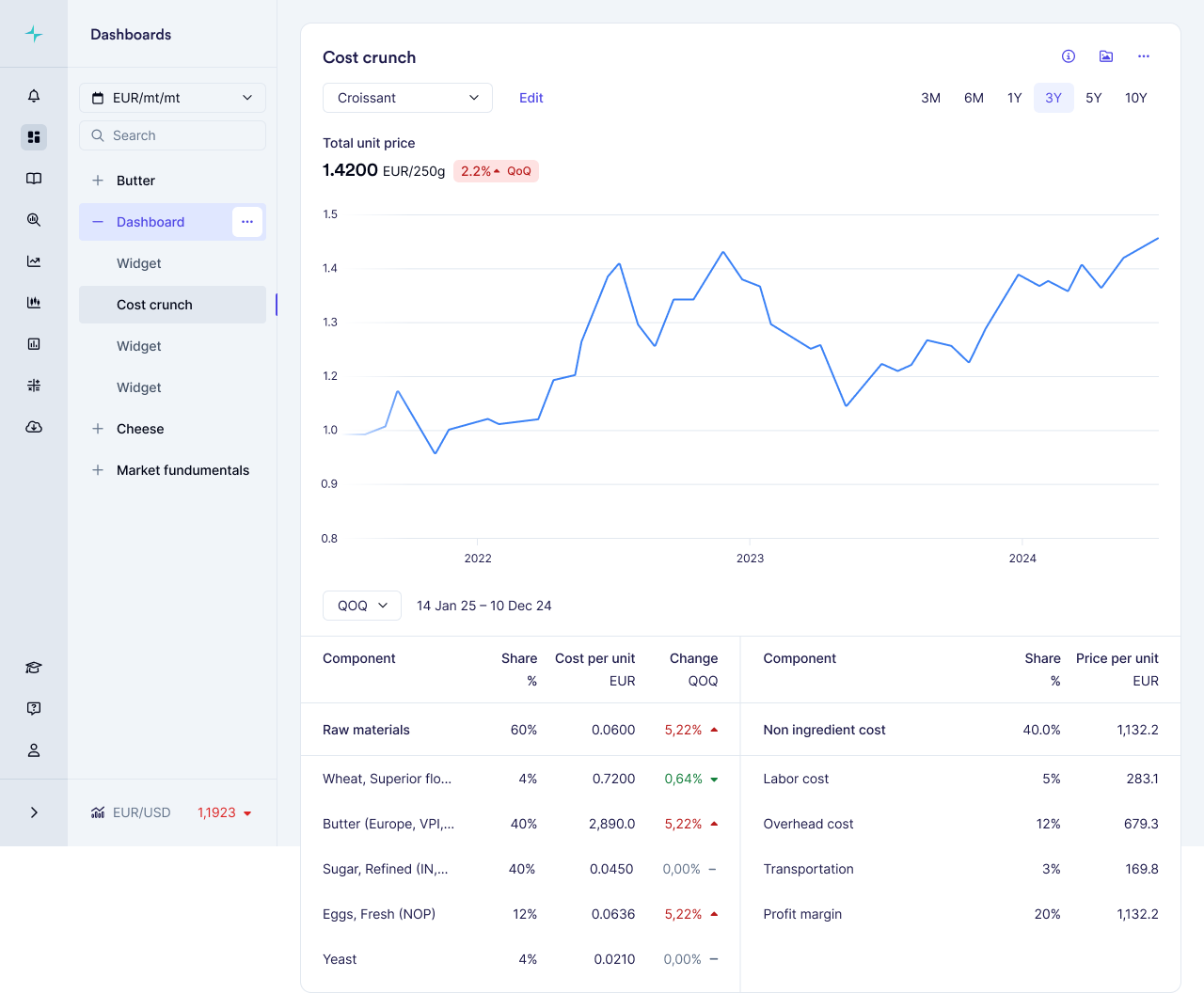
  • Build complete product cost models by combining multiple commodity benchmarks with precise weightings

  • Access industry-standard non-ingredient costs (labor, manufacturing, overhead) specific to your region

  • Choose from our template library for common food products or create custom models

  • Track how each component contributes to your total product cost with automatic updates whenever source prices change

Why It Matters: With record-high volatility across food commodities, understanding how ingredient changes impact finished products is critical for maintaining margins. Cost Models provide complete cost structure visibility for your entire organization: procurement teams can verify supplier price increases, finance can track margin impacts across product portfolios, and sales teams can justify price adjustments to customers with independently verified data. Non-ingredient costs can represent up to 47% of total product costs—a critical component that's now visible alongside your commodity benchmarks.

How to Use It:

  1. Access Cost Models through the main dashboard menu

  2. Choose between starting with a template or building a model from scratch

  3. Select ingredients from your available commodities and assign precise weightings

  4. Add country-specific non-ingredient costs by selecting your industry and location

  5. Save your model to track cost evolution over time as prices update automatically

Related Features: Cost Models integrates seamlessly with Vesper's existing capabilities:

  • Individual commodity price benchmarks (VPI, Partner prices, and Public benchmarks found in prices widgets)

  • Incorporate into your own custom dashboards

  • Coming in Q3 2025: Forecasting capabilities for your cost models

Did you like this update?

LikeNeutralDislike

Introducing Brazilian Instituto de Economia Agrícola (IEA) Source

by Vesper Team
New
Data
Nuts, Seeds & Dried Fruits
Meat & Poultry
Vegetables & Pulses

Added daily Brazilian public prices from Instituto de Economia Agrícola (IEA), Brazil's leading agricultural economics institute, expanding our coverage of key food commodities with local market data.

Why it Matters: Brazil is a major global producer and price setter for multiple food commodities. Direct access to daily IEA data provides unprecedented visibility into local market dynamics, helping procurement teams better understand price movements at origin and optimize sourcing strategies.

What's New:

  • Daily price updates across multiple categories:

    • Meat & Poultry: Chicken cuts (breast fillet, thigh, leg quarters), Pork cuts (loin, steak), Beef cuts (ribeye, round eye, brisket)

    • Nuts & Seeds: Peanuts in shell

    • Vegetables: Garlic (violet, violet size 0.7)

  • Key features:

    • Daily frequency updates

    • 4 years of historical data

    • Local market prices from São Paulo state

    • Original source data direct from IEA

How to Use It:

  1. Access Brazilian benchmarks in the Prices widgets by searching for the product name or filtering by BR-IEA source

Did you like this update?

LikeNeutralDislike

New Brazilian Nuts Production Data

by Vesper Team
New
Nuts, Seeds & Dried Fruits
Bakery
Data
Chocolate, Confectionery & Ice Cream

NewNuts & SeedsProduction Data

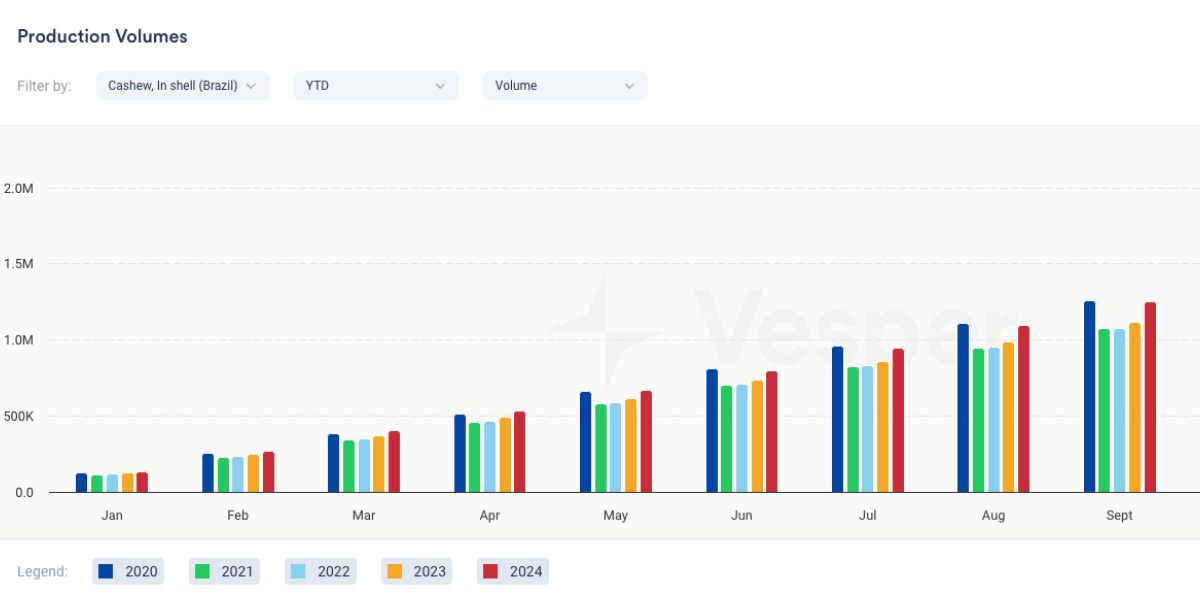
Summary: Monthly production data from IBGE (Brazilian Institute of Geography and Statistics) for cashews and peanuts, providing official Brazilian production volumes and trends.

What's New:

  • Monthly cashew production data (in shell)

  • Monthly peanut production volumes (combined 1st and 2nd harvests)

  • Data presented in metric tons

  • Direct integration with IBGE statistics

  • Monthly update frequency

Why It Matters: Brazil's position as a major nuts producer means their production volumes directly impact global supply and prices. This data helps you anticipate market movements and optimize procurement timing based on production cycles.

How to Use It:

  1. Access the Production widgets in your dashboard

  2. Use the search function to find "cashew" or "peanut" data

  3. Select Brazilian production data from the results

Related Features: This release complements our recent expansion of nuts and seeds price data, where we've added more historical data points across all pricing widgets to give you a deeper view of long-term market trends.

Did you like this update?

LikeNeutralDislike