Vesper  Updates

1,800+ new Vesper Forecasts now live

by Vesper Team
New
Forecasting & Outlook
Data
AI

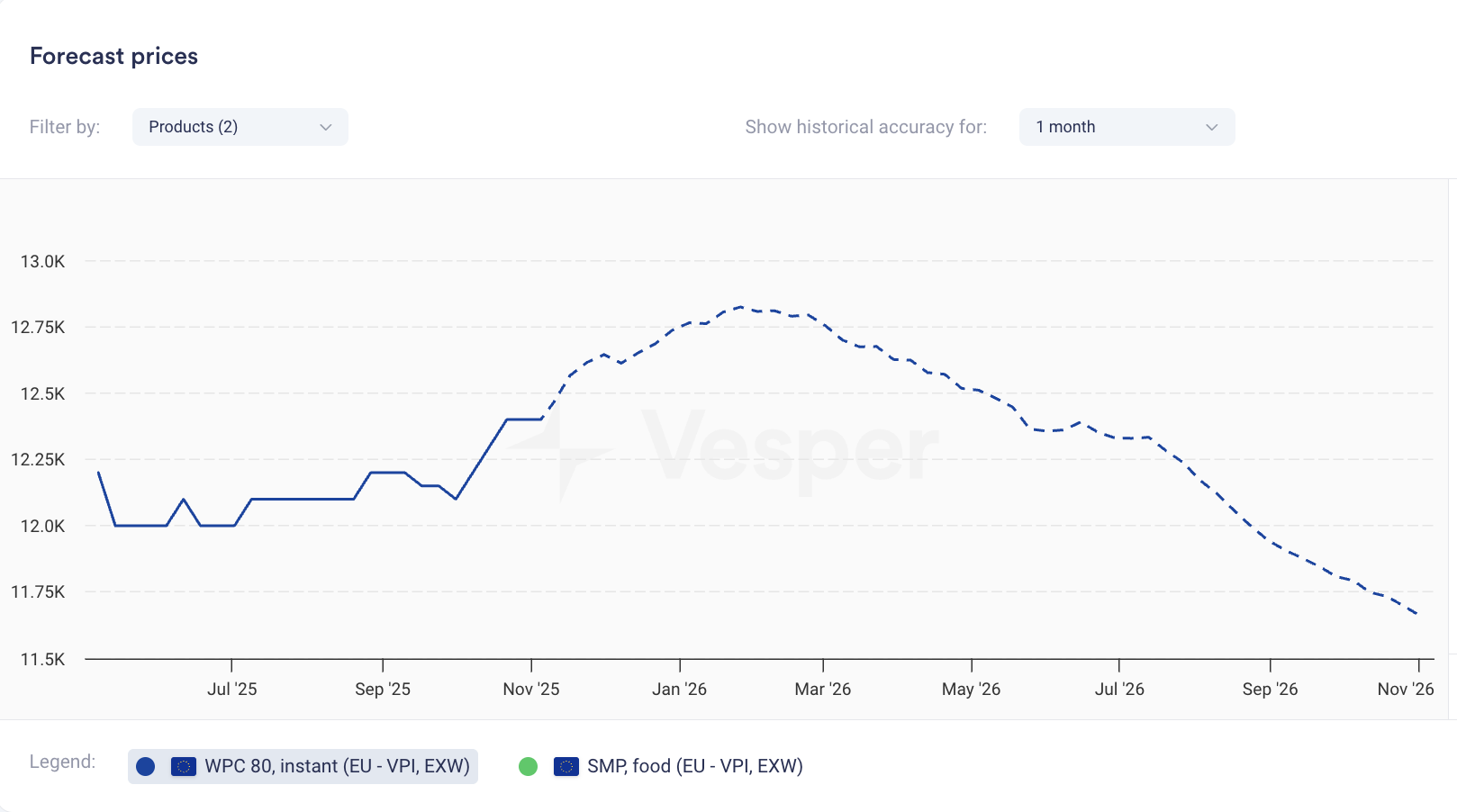
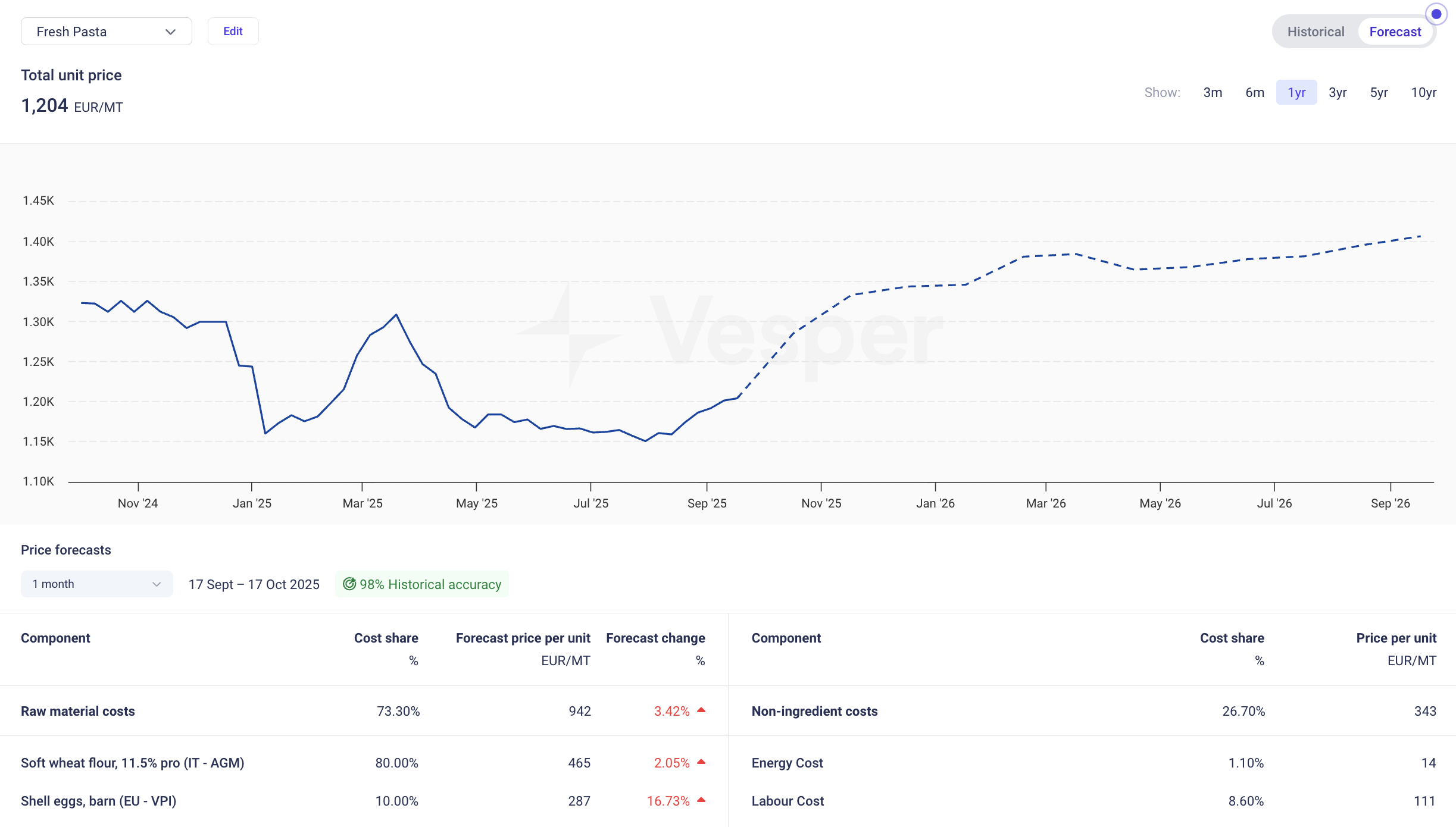
Vesper has added forecasts on 1,800+ additional price series, covering both Vesper's own data and third-party sources. All forecasts run up to 52 weeks ahead.

What's new:

  • 1,800+ new Vesper Forecasts now live

  • Coverage includes US price series added through recent partnerships, European series, and Vesper Price Index benchmarks

  • All forecasts run up to 52 weeks ahead with confidence intervals

  • This is a major expansion for US-sourced data in particular, where forward price visibility was previously limited

Why this matters:

Buying decisions are forward-looking, but most price tools only show history. Vesper Forecasts give you a forecasted price for planning purchases, reviewing budgets, or deciding whether to lock in now or wait. With 1,800+ additional series covered, buyers in categories like grains, oils, meat, and packaging can access forward views for both US and European markets. And because forecasts cover third-party sources too, you get forward visibility on the same benchmarks your suppliers reference.

How to Use It:

  • Price Forecast widget: add any covered series to see the 52-week forward projection

How to access?

Add the Price Forecast widget to new or existing dashboards using the search function, or contact your Customer Success Manager at [email protected].
Major US Price Expansion: 286 New USDA Series

by Vesper Team
New
Data
Vegetables & Pulses
Fruit
Meat & Poultry
Food Ingredients
Grains & Feed
Oils & Fats
Herbs & Spices
Chemicals
Sugar & Sweeteners

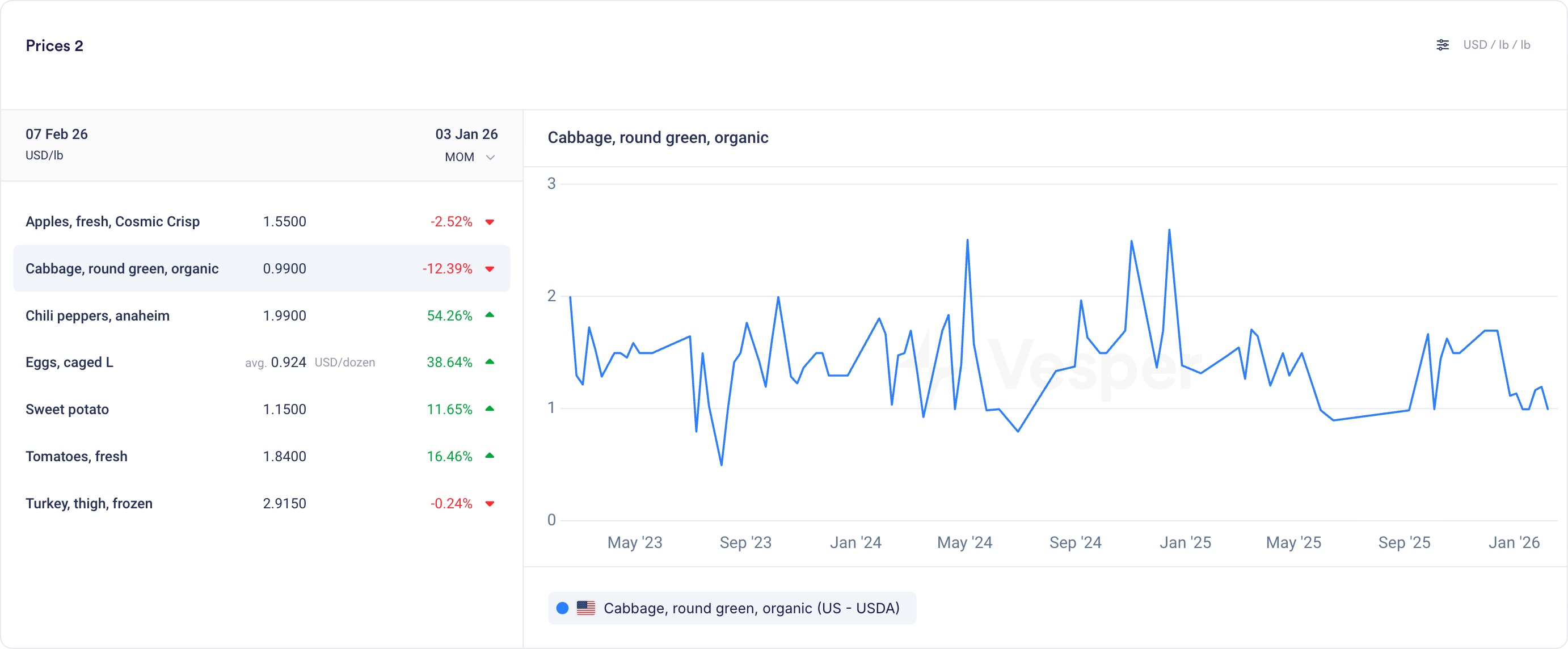
Vesper now includes 286 new price series from 13 USDA MARS reports, one of the most widely referenced public pricing sources in US agricultural markets. This is our largest single USDA expansion to date.

What's New:

  • Vegetables & Pulses: 107 new price series including potatoes, tomatoes, bell peppers, onions, carrots, broccoli, squash, black beans, pinto beans, lentils, chickpeas, and yellow peas

  • Fruits: 80 new price series covering apples (Gala, Honeycrisp, Fuji, Cosmic Crisp and more), oranges, grapes, strawberries, peaches, pears, bananas, kiwi, and watermelon, including organic variants

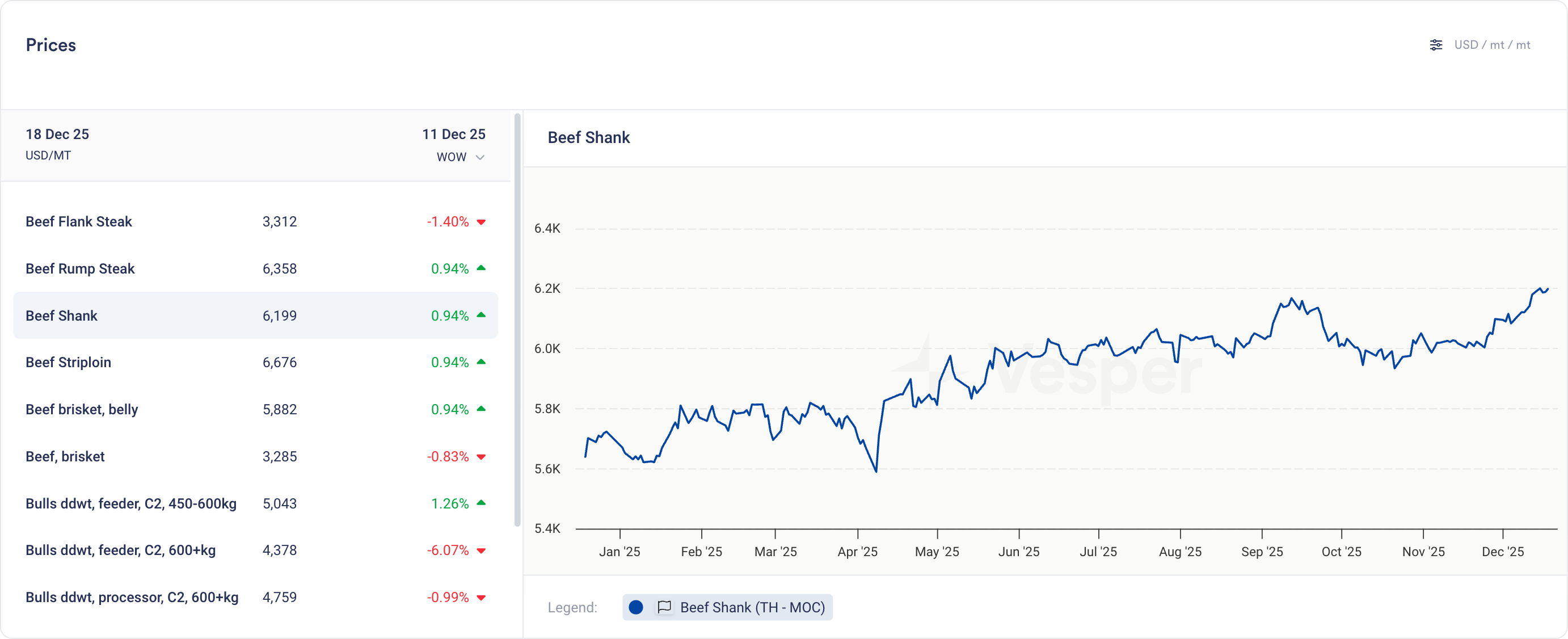
  • Meat & Poultry: 39 new price series for beef primal cuts (ribeye, tenderloin, strip loin, chuck, round), lamb (rack, leg, shoulder), turkey (whole, breast, drumsticks, wings), hog, and cattle live/dressed weight prices

  • Food Ingredients: 29 new price series for eggs (caged and free-range across multiple sizes and regions) and ethanol

  • Grains & Feed: 14 new price series for alfalfa, corn (food and feed grade), soybean, DDGS, corn gluten, cottonseed, canola meal, and blood meal

  • Oils & Fats: 8 new price series including choice white grease and animal fat derivatives

  • Herbs & Spices: 5 new price series for jalapeño, serrano, poblano, anaheim chili peppers, and garlic

  • Chemicals: 3 new price series

  • Sugar: 1 new price series

See the complete product list for all 286 series.

Why It Matters:

USDA MARS reports are among the most commonly referenced pricing benchmarks in US agricultural markets. These 286 series bring that coverage directly into Vesper, so you can track US prices for fresh produce, proteins, grains, feed ingredients, and eggs alongside your existing European and global series, all in one place.

How to Use It:

  • Prices Widget: Search for specific products (e.g., "beef ribeye" or "apples Honeycrisp") to bookmark USDA MARS prices alongside your existing series

  • Price Comparison: Compare USDA US prices with European or global equivalents for with different prodcut names

  • Cost Models: Add USDA ingredient prices to your cost models for a more complete picture of US-sourced product costs

How to access?

Add to new or existing dashboards using the search function, or contact your Customer Success Manager at [email protected] for any questions.

Australian Red Meat Market Report

by Vesper Team
New
Market Analysis
Meat & Poultry

Vesper now includes a monthly market report covering the Australian red meat market, produced by Episode 3 (EP3), an independent, data-driven market analysis service focused on agriculture and food manufacturing.

Australia is one of the world's largest beef and lamb exporters, and this report brings structured analysis of that market directly into the platform.

What's New:

  • Two sections: Beef and Lamb, covering export statistics, slaughter ratios, herd size, and processor margins

  • Monthly frequency: Updated each month with the latest Australian market data

  • Complements existing coverage: Sits alongside the US Meat report for cross-regional comparison

Why It Matters:

Australian beef and lamb prices are a key reference point for anyone sourcing red meat globally. This report adds structured context on supply conditions, processing economics, and trade flows that is difficult to piece together from scattered public sources.

How to access?

The report is available in the Market Analysis section of the platform. Contact your Customer Success Manager at [email protected] if you need help locating it.

Read the latest report

Poultry Market Analysis

by Vesper team, Product Marketing
New
Meat & Poultry
Market Analysis
Forecasting & Outlook

Vesper now covers poultry with in-house expert analysis. Our first Poultry Market Analysis report is live in the Market Analysis section.

What's new

  • In-house written market report covering global poultry markets

  • Global origins covered: Thailand and Brazil

  • European origins covered: Poland, Spain, and Ukraine

  • Published bi-weekly on Thursdays

  • Available in the Market Analysis section alongside Dairy, Oils & Fats, and other category reports

Why this matters

Poultry is a key category for food manufacturers, retailers, and food service buyers, but reliable market analysis has been hard to find. This report gives you the same depth we bring to other categories: price drivers explained, supply context, and forward-looking outlooks.

Whether you're sourcing chicken breast from Brazil or tracking Polish production trends, you now have a consistent, independent view of the market.

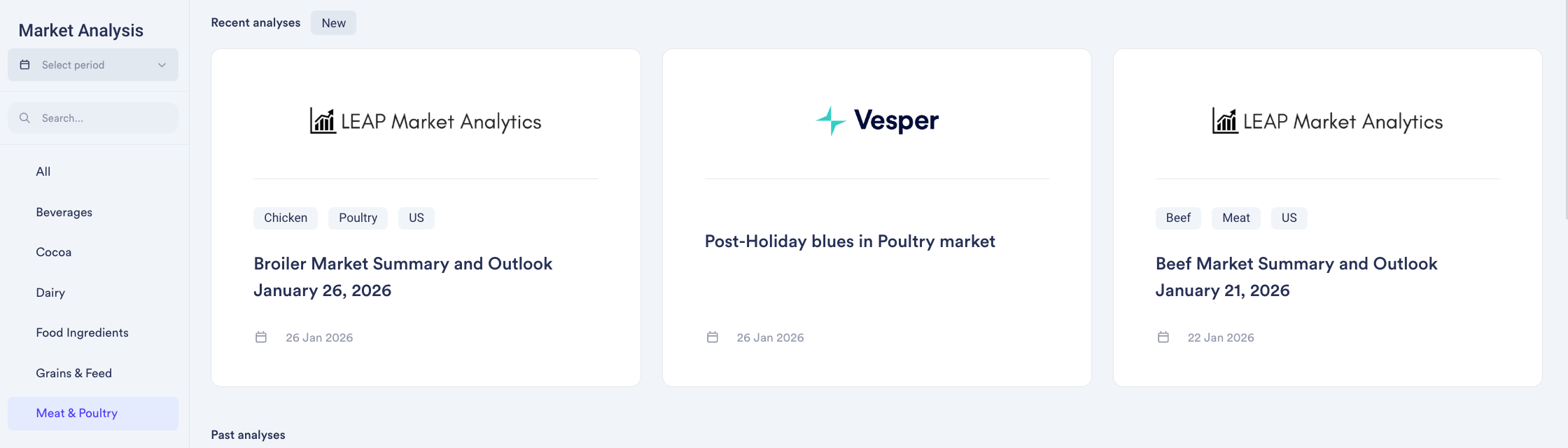
Already using Vesper for meat? This report joins our existing US Beef and Chicken coverage from partner Leap Market Analytics, giving you both American and global market perspectives.

Did you like this update?

LikeNeutralDislike

Major USDA data update: US meat prices and global Supply & Demand

by Vesper Team
New
Data
Meat & Poultry

Vesper has added 189 USDA meat price series and 1,406 new Supply & Demand series in one update.

What's new:

  • 189 daily and weekly USDA Market News meat price series, covering beef, pork, lamb, and poultry across major US markets
  • 1,406 new Supply & Demand series sourced from USDA PSD (Production, Supply, and Distribution) and FAO Stat
  • S&D series span production, domestic consumption, ending stocks, and trade flows across key exporting and importing countries

Why this matters:

US government meat pricing gives you an independent reference point for benchmarking quotes. The Supply & Demand series add production and trade context behind price moves, so you can see whether a price shift is structural or seasonal.

How to Use It:

  • Prices Widget: search for USDA meat price series by product, market, or frequency
  • Price Comparison: stack US meat prices against other regional benchmarks
  • Supply & Demand widget: access production, consumption, stock, and trade flow data alongside your price charts
  • Cost Models: incorporate live US meat prices into your ingredient breakdowns

How to access?

Add to new or existing dashboards using the search function, or contact your Customer Success Manager at [email protected].
Expanded Meat & Poultry Coverage Across Brazil, Australia, and Thailand

by Vesper Team, Product Marketing
New
Meat & Poultry
Data

Vesper has expanded its Meat & Poultry coverage with 249 new price series across three major protein markets: Brazil, Australia, and Thailand. This release adds daily and weekly pricing for beef, poultry, pork, and lamb, strengthening our global protein intelligence for teams sourcing across multiple origins.

What's New:

  • Brazil: 52 daily price series for chicken, beef, and pork, including 32 entirely new products.

  • MLA (Australia): 112 weekly saleyard prices for cattle (68 series) and sheep (44 series), based on physical auction transactions. All prices stored on a carcass-weight basis.

  • Mexmoc (Thailand): 85 weekly price series covering meat, poultry, and related products, including 72 entirely new additions.

Why It Matters: Global protein sourcing requires visibility across multiple origins to compare pricing, validate supplier quotes, and anticipate supply shifts. Brazil, Australia, and Thailand represent critical benchmarks for international meat buyers, yet consistent, structured pricing across these regions has historically been difficult to access in one place. This expansion gives procurement teams the cross-regional view needed to negotiate with confidence and identify cost-saving opportunities.

How to Use It:

  • Prices Widget: Bookmark key products (e.g., Brazilian chicken, Australian cattle, Thai pork) for quick access to the latest prices.

  • Price Comparison: Compare pricing across origins or protein types to spot arbitrage opportunities or validate regional quotes.

  • Cost Models: Add these series as ingredients in your Cost Models to track input costs for prepared foods, food service menus, or retail protein products.

How to access? Add to new or existing dashboards using the search function, or contact your Customer Success Manager at [email protected] to confirm which specific products are currently active for your region.

Did you like this update?

LikeNeutralDislike

New Vesper Price Index: WPC80 Regular (US & EU)

by Vesper Team, Product Marketing
New
Vesper Price Index (VPI)
Specialized Nutrition
Sports Nutrition
Dairy

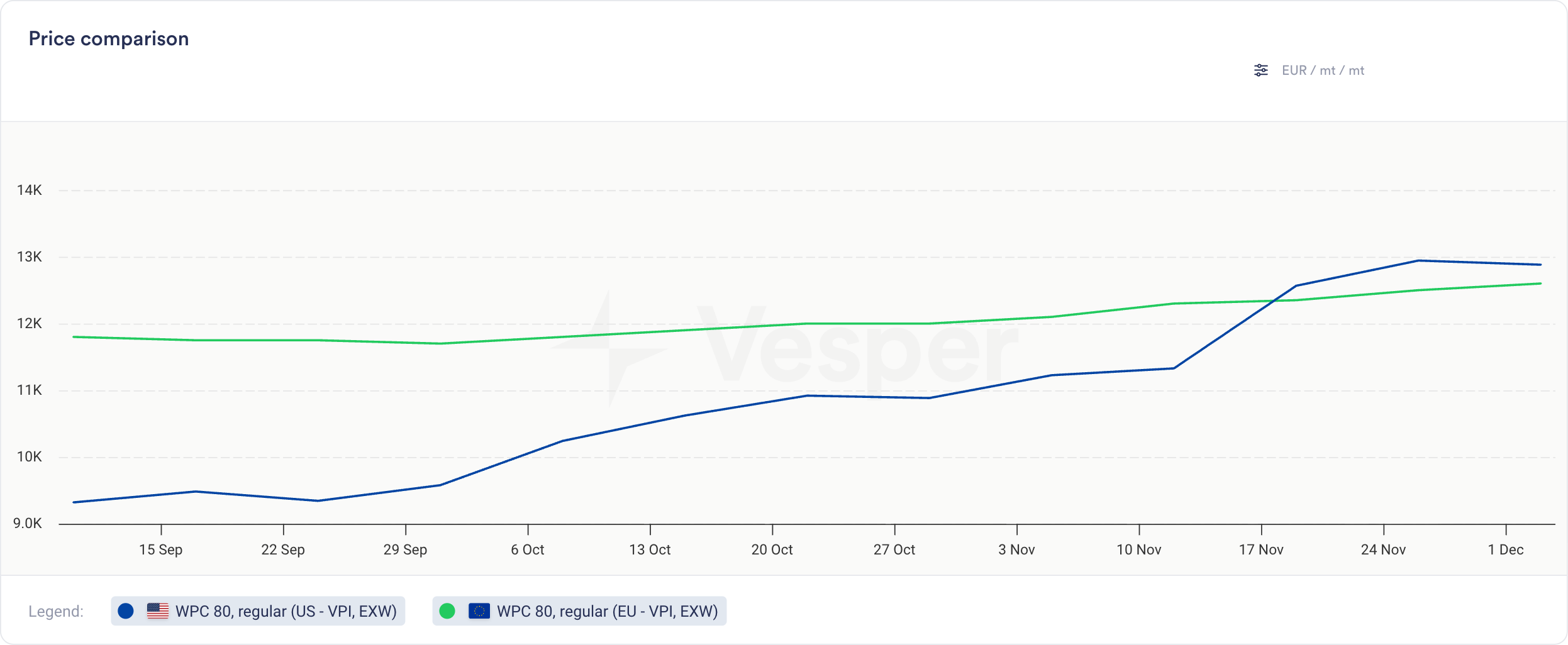
Vesper has expanded its proprietary specialty dairy protein coverage with two new Vesper Price Index (VPI) benchmarks: WPC80 Regular US and WPC80 Regular EU. Published every Wednesday, these benchmarks provide independent, region-specific price visibility, allowing procurement teams to track actual market spreads rather than relying on fixed premium assumptions or generic proxies.

What's New:

  • Weekly Regional Benchmarks: Prices for WPC80 Regular in the US and EU, published every Wednesday.

  • Verified Market Input: Prices derived from verified active market participants—both buyers and sellers—so you see where trade is actually getting done.

  • Deep Specialty Coverage: Strengthens Vesper’s unique position in specialty proteins, joining our existing benchmarks for WPC80 Instant, MPCs, WPI, Caseinates, and other niche protein products.

Why It Matters:

Relying on "80 Instant" for "Regular" WPC80 can hide the actual cost. These new Vesper benchmarks provide the independent reference needed to verify quotes against actual market prices. By establishing a shared view of the market, buyers and sellers can align on price faster, ensuring fair trade and reducing the time spent negotiating over data sources.

How to Use It:

  • Prices Widget: Bookmark the US and EU prices for one-click access to the latest Wednesday publication.

  • Price Comparison: Compare the new WPC80 Regular prices to the Instant variant and use the Spread function to instantly visualize correlations, spot patterns, and track how the price gap evolves over time.

  • Cost Models: Select these new benchmarks as ingredients in your Cost Models to see product costs with WPC80 Regular as an ingredient.

How to access?

These benchmarks are live for all Vesper users with access to the Dairy module. Contact your customer success manager at [email protected] for help integrating these new indices into your dashboard.

Did you like this update?

LikeNeutralDislike

Weekly Forecasts

by Vesper Team, Product Marketing
New
Forecasting & Outlook
Improvement
AI
Data

Price forecasts now display weekly data points instead of monthly. The same 12-month coverage now gives you 52 weekly forecasts; 6-month coverage gives you 26 weekly forecasts.

What it does: Shows forecast at weekly intervals rather than monthly What you can do: Track expected price movements week-to-week and time purchases more precisely Why it matters: Spot trends between monthly intervals and answer the tactical question: commit this week or wait? Especially valuable when markets are volatile.


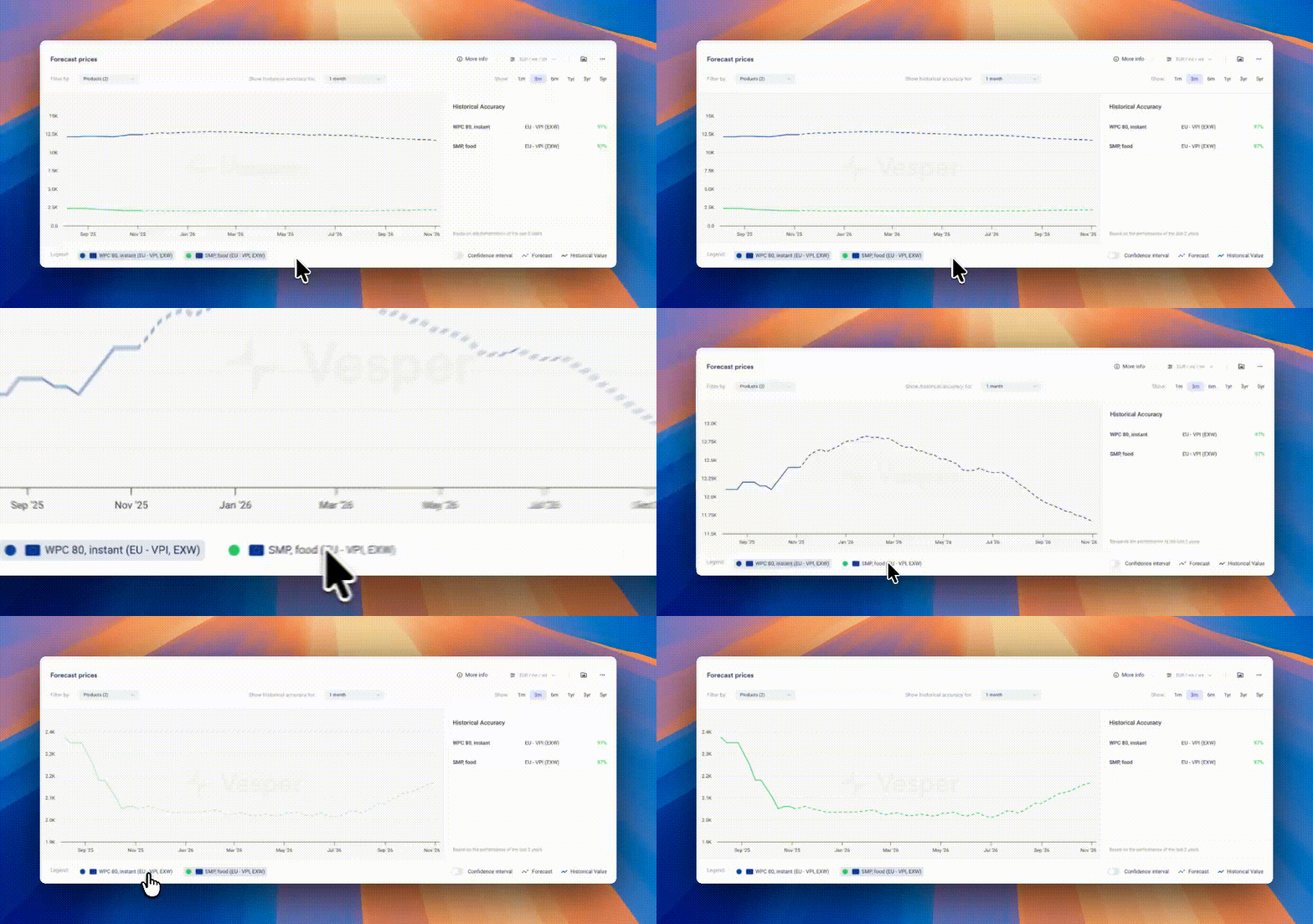
Pro Tip: If forecasts look flat due to scaling (multiple products or long price histories compress the view), zoom in on the graph, temporarily hide other products using the legend, or hover for exact forecasted values.

Did you like this update?

LikeNeutralDislike

Cost Model Forecast & Collaboration

by Vesper Team, Product Marketing
New
Cost Models
Forecasting & Outlook
AI

Vesper has launched Advanced Cost Model Collaboration & Forecasting, transforming how procurement teams build, share, and predict product costs. These features eliminate silos between team members and bring AI-powered forecasting directly into your cost models, enabling real-time collaboration on forward-looking procurement strategies.

What's New:

  • Cost Model Forecasting: View your total product costs up to 12 months ahead (depending on forecast availability). Toggle between historical and forecasted values with full accuracy calculations, detailed forecast tables showing price movements per ingredient, and weighted accuracy scores.

  • Cost Model Sharing: Share any cost model across your organization with granular access controls. Grant view-only permissions for stakeholder reviews or edit access for joint development, with all shared models appearing in a dedicated library.

  • Cost Model Collaboration: Work collaboratively on shared models with real-time updates visible to all collaborators. Receive notifications when colleagues share models or make edits, ensuring alignment on the latest cost structures.

Why It Matters: Cost models trapped in individual spreadsheets create bottlenecks and duplicate work. Meanwhile, static historical data leaves teams reactive rather than proactive. This update enables procurement teams to collaborate on living cost models that look forward, not only backward, turning isolated analysis into coordinated teamwork with visibility into future cost drivers.

How to Use It:

  1. Access forecasting by clicking the toggle in any cost model widget to switch between historical and forecast views

  2. Share models by selecting "Edit" in the cost model widget, then using the share option under "Access"

  3. Set permissions as either "Can view" for stakeholder visibility or "Can edit" for collaborative development

  4. Find shared models in the dedicated section of your cost model dropdown, marked with company models

  5. Monitor changes through the Notifications banner for updates on shared models

How to access? These features are live for all Vesper users. Contact your customer success manager at [email protected] for training on maximizing collaboration workflows.

Did you like this update?

LikeNeutralDislike